A Low-Key Sunday Reset for the Week Ahead
A Sunday reset for the week ahead helps you check fixed commitments, prepare for one real need and keep breathing room without turning Sunday into a workday.

How can a Sunday reset for the week ahead help Monday feel less crowded without taking over your day off? Start with the commitments already in your calendar, then make a few small decisions about what needs attention and what can stay open. You do not need to plan every hour.
Keep the routine close to the shape of your actual Sunday. You might check your calendar at the kitchen table after breakfast, then put one useful item by the door. If the routine starts to feel like another job, leave out anything that does not help.
What should you check before making a plan?
Look at the coming week’s fixed commitments: a shift, school meeting, delivery window or appointment. Include travel and the time you may need to get ready or recover afterwards. These details show where the week is already spoken for.
Then ask what would make the week easier to handle. Perhaps you need to send a form, prepare for a conversation or keep an evening clear after a demanding day. Choose based on your circumstances, not on what a packed planner might look like.
For a quick check, use these observations to decide what belongs in the plan:
- If a commitment has a confirmed time and place, keep it in the calendar; if it is only a possibility, leave it tentative until confirmed.
- If travel or preparation affects when you can start another task, leave room around the commitment; if it does not, avoid adding unnecessary blocks.
- If a deadline falls this week, choose its next visible action; if there is no immediate deadline, consider leaving it for later.
- If a day already includes work, care or an appointment, avoid assigning it another demanding task; if a genuine opening remains, place one suitable priority there.
- If an item is needed for a specific outing, set it by the door or pack it; if no upcoming situation calls for it, do not stage it just in case.
- If a task can wait without causing a problem, move it to a later note or drop it; if forgetting it would cause difficulty, keep it visible.
- If a plan depends on someone else confirming details, leave that part open; if the details are settled, add the next action to your calendar or note.
Say you have a late Tuesday shift, a Thursday appointment and an application form waiting for missing details. You check the calendar, leave Tuesday evening free, and choose Monday lunchtime to gather the details, with a reminder to submit the form after checking them. The resulting plan identifies a realistic next action without pretending the form is already complete; if Monday becomes crowded, you can move the task rather than add it to Tuesday.
How do you choose priorities without filling every day?
Choose a small number of outcomes that matter, then name the next action for each. “Send the application” is easier to recognise as complete than “sort work stuff”. If a task needs several stages, record only the next one you can see clearly.
A priority deserves attention; a reminder simply helps you remember a detail. Keep both somewhere easy to scan, such as the calendar you already use or a note beside it. You do not need a new app or a more elaborate system for a Sunday reset.
If the list grows, ask which task would be most useful to move forward or most troublesome to forget. Keep that one in view and put the rest aside for now. A short list is a set of choices, not a promise that everything will be finished.
What is worth setting aside for the week?
Pick one item linked to a real upcoming situation: a library book for a planned return, a reusable bag for an errand, a permission slip for school or a folder for an appointment. Put it where you will naturally see or collect it. An item staged for a specific outing is like leaving your keys in their usual bowl: it helps because you know where to look.
Imagine you have a library book to return on a day you will already pass the library. On Sunday, you put the book in your work bag and check that the bag is by the door. The observable result is that the book is ready to go; if your route changes, take it back out rather than treating the arrangement as binding.
One item may be enough. If a particular day calls for more preparation, handle that need directly, but do not turn every Sunday into a staging area for clothes, meals and equipment.
How much time should you leave unplanned?
Keep some time without an assigned task. That might be an open evening, a slower morning or a gap between commitments. The right amount depends on work, care responsibilities and energy; you do not need to justify it as productive.
Unclaimed time leaves room for a delayed journey, an unexpected message or a task that takes longer than expected. If nothing interrupts it, you can keep it open. Check for days where one commitment runs straight into another, and allow for meals, travel and transitions where needed.
If an empty evening makes you uneasy, make the boundary specific: do not add an errand to one evening, or leave one day’s gap after an appointment. If a new commitment later becomes necessary, decide what to move or drop instead of quietly stacking it on top.
What if the week changes after Sunday?
Treat your plan as provisional. An appointment may move, a priority may become less urgent or the item you set aside may no longer be needed. Update the arrangement when circumstances change rather than treating an old decision as a rule.
At a natural pause, such as before leaving home or on Monday evening, check whether the priorities still make sense. If a new commitment appears, choose what to reschedule, reduce or remove. A brief adjustment is more useful than trying to preserve a plan that no longer fits.
Which Sunday reset questions are worth asking?
How long should a Sunday reset take?
Keep it short enough that it does not take over your day off. If it begins to expand, make the most useful decision and stop there.
What if I do not know what the week will bring?
Plan around confirmed commitments and choose only the next actions you can see clearly. Leave uncertain details open until you have enough information to decide.
Should I plan meals and chores as part of the reset?
Only if a particular meal or household task would ease a real pressure that week. You can note that one need without scheduling every domestic task.
What if I miss Sunday?
Use another quiet moment, or make one decision when it becomes useful. The routine can happen on a different day or be skipped when it would add strain.
How can you keep the routine low-key?
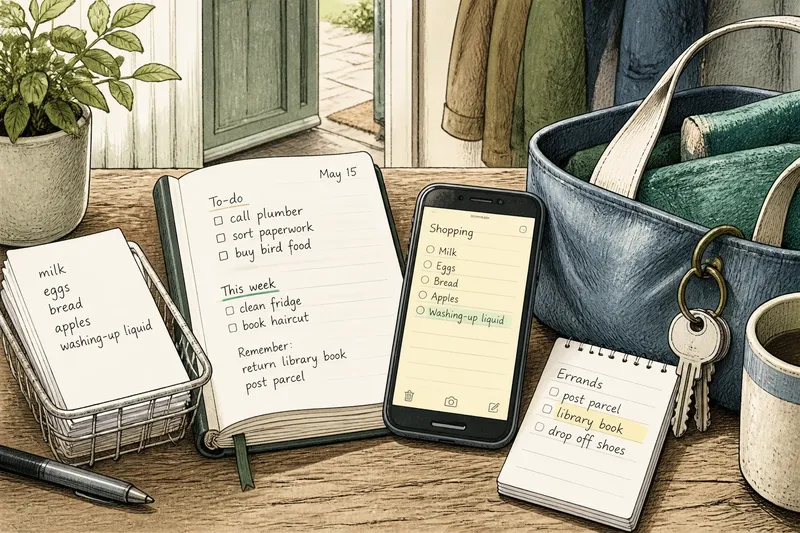
Use a calendar, scrap of paper, phone note or notebook you already have. Write in plain language, keep the plan easy to find and leave out steps that do not help. On a tiring or crowded Sunday, a glance at fixed commitments and one useful preparation may be enough.
A Sunday reset for the week ahead is most useful when it leaves you with a few clear choices and room to adjust. Before putting your note away, decide where you will check it next. If the week changes, let the plan change with it.