The Decluttering Myth: Empty Is Not the Goal
The decluttering myth says less is always better. Judge belongings by their use, meaning and space to make a home easier to live in.
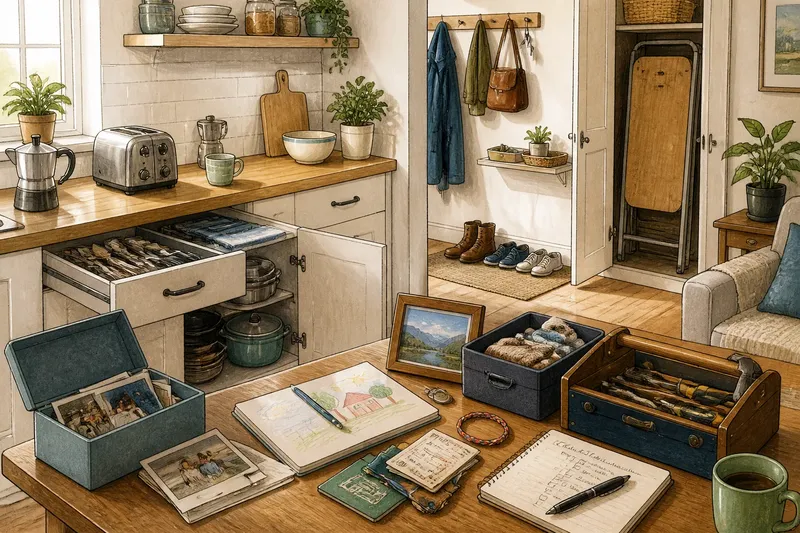
When a cleared kitchen counter makes you wonder where the toaster should go, the decluttering myth may be steering you towards the wrong goal. A home does not become better simply by containing less. The useful question is whether your belongings support the life you lead, carry meaning you value, and fit the space you have.
That sounds straightforward until you face a box of keepsakes, a crowded cupboard or a room that looks tidy but feels awkward to use. The trouble often comes from treating every object as either clutter or a candidate for the bin. A more grounded approach is to notice what is causing friction, understand why, then try a change that suits the specific problem.
Why does a tidy room still feel hard to use?
Sometimes the problem is not the number of objects but where they are. A clear worktop can be inconvenient if the things you use to make breakfast are stored on a high shelf or behind rarely used cookware. Removing more may make the room look spare without making everyday tasks easier.
Consider the route through the room. Do you have to move a chair to reach a wardrobe? Does the vacuum cleaner block the cupboard where you keep cleaning cloths? These small obstacles are clues about how the space is working, not proof that you have failed to declutter.
Try grouping objects by the task they serve and keeping the most frequently used ones within comfortable reach. If a large appliance is used often, it may earn its place on the counter. If an occasional serving dish occupies prime cupboard space, it might work better on a higher shelf. The aim is a room that supports ordinary movement, not a photograph with nothing in sight.
Why do you keep removing things you later need?
This often happens when decisions are made under pressure: during a big clear-out, after seeing an almost-empty room online, or when a pile feels overwhelming. In that moment, “keep less” can sound like a simple rule. But an object that has a clear role does not become unnecessary just because it is not used every day.
Look at the actual pattern of use. A spare duvet may be needed for visiting family; a toolkit may come out only for occasional repairs. Ask whether the item solves a real, recurring need, whether you can locate it when needed, and whether there is a suitable alternative already in the home. If its role is clear and it has an appropriate place, keeping it can be more sensible than discarding it and later replacing it.
Imagine you own a sturdy folding table that comes out for craft projects and family meals but otherwise sits in a hall cupboard. The cupboard is difficult to open because the table is wedged beside shoes. Rather than deciding the table is clutter, you could move it to a less crowded storage area and place a hook or tray near the entrance for the shoes. The observable result to look for is easier access to both, not a home with one fewer useful object.
Why does sentimental clutter feel so difficult to sort?
Objects can carry a memory, a relationship or a sense of an earlier version of yourself. That meaning is not measured by how often you use the object, and it need not be justified to anyone else. The difficulty arises when every meaningful item is treated as equally important, leaving no room to choose what you can comfortably keep.
Instead of asking whether a keepsake is “worth keeping”, ask what you want to remember and which object best holds that connection. A bundle of school drawings might include one picture that captures a particular moment; a ticket or programme may bring back an occasion more vividly than a whole box of papers. If you choose to let some things go, you are choosing among objects, not erasing the experience.
Give meaningful belongings a defined place that suits your home: a small box on a shelf, a frame on a wall or a folder in a drawer. That boundary can help you make choices without demanding that memories be reduced to nothing. If a particular decision feels raw, pause and return to it later rather than turning sorting into a test of willpower.
Why does storage make the problem seem to grow?
Buying another basket or stack of boxes can conceal the cause of a crowded room. The belongings may not have workable homes, or their storage may be awkward to reach. A container can keep objects together, but it cannot decide whether they belong there or make a daily routine more convenient.
Before adding storage, notice what spills out and why. Is it a collection of items used in one place? Is it a mixture of things waiting for different decisions? A shallow tray beside the front door can suit keys and post; a deep box may bury small objects and make them harder to find. Choose a container only when its size and opening suit what you intend to store.
Think of storage like a shelf in a small shop: it should help you see and reach what you need, not merely hide the stock. If a cupboard is packed so tightly that taking one thing makes several others fall, shifting less-used items elsewhere may improve access more than adding another container. Keep the items you reach for often in the easiest places.
What should you ask before deciding an item belongs?
How often do I use it?
Frequency is a useful clue, but not the only measure. An item used rarely may still serve a specific occasional need, while something used daily may be awkward enough to replace or relocate.
Does it have a clear place?
A useful object left on the floor can still create friction. Ask whether its current home is convenient and whether another arrangement would make putting it away realistic.
What meaning does it hold for me?
Meaning can be a good reason to keep something, even if it is not practical. Consider whether the object itself matters, or whether another keepsake represents the same memory more clearly.
What space does it take, and what does that space need to do?
Notice the room, shelf or drawer an item occupies and what else you need there. A bulky belonging may be worth keeping, but a better location could free the area for something you use more often.
How can you make a small change without starting a purge?
Choose one trouble spot rather than setting out to empty a whole room. A bedside table, coat hook or kitchen drawer offers a manageable place to see whether a different arrangement helps. Take everything out only if that makes it easier to understand what is there; you do not need to turn the task into an all-day project.
Sort by what the items do, not by an abstract ideal of how many you should own. Keep the things that belong in that spot, move items that have a better home, and set aside anything you cannot decide about without forcing an answer. Then use the space as you normally would and notice what is still inconvenient.
For example, imagine a person whose entryway bench is buried under reusable bags, gloves and post. They could give the bags a hook, put gloves in a small bowl on the bench, and move post to a tray elsewhere. The useful sign of progress would be being able to sit down and find the gloves, not having an empty bench at all times.
There is no single correct number of belongings for a home. A useful decluttering decision respects both the object and the space around it: what it does, what it means, how easily you can reach it, and what its location makes harder. The decluttering myth loses its grip when “less” stops being the measure of success and a home that works for you becomes the aim.